
Forest Breathing
The air in a Norwegian forest is chemically different from city streets. Learn what you breathe in woodland environments and how to make the most of it through paced walking and conscious respiration.
Optional free newsletter. Unsubscribe anytime by contacting us. We do not sell personal data. See our Privacy Policy.







What Makes Forest Air Unique
Trees and plants release bioactive compounds into the atmosphere. The most studied group — phytoncides — are antimicrobial volatile organic compounds produced by conifers, oaks, and birch species. When you walk through a forest, you inhale these compounds along with air that typically contains higher oxygen levels and lower concentrations of nitrogen dioxide, particulate matter, and ozone than urban environments.
Researchers in Japan have studied shinrin-yoku (forest bathing) for decades. Some controlled studies note that participants felt more relaxed after quiet woodland walks compared with urban settings. We describe this research for general interest — our site does not offer forest therapy or medical programmes.
Norway's forest composition varies by region. Telemark's woodlands feature a mix of Norway spruce, Scots pine, and silver birch, each contributing distinct phytoncide profiles. Spruce-dominated areas near Porsgrunn release higher concentrations of alpha-pinene and limonene, while birch groves contribute betulin-related compounds with their own atmospheric signatures.

Nasal Breathing During Woodland Walks
Nasal breathing serves as a natural filter and humidifier. The nasal passages trap particulate matter, warm incoming air to body temperature, and add moisture that protects airway tissues. During forest walks, nasal breathing also extends contact time between inhaled phytoncides and the rich vascular network of the nasal mucosa and upper respiratory tract.
Practice the 4-6 breathing pattern during slow forest segments: inhale through the nose for four counts, exhale through the nose for six counts. Many walkers find a longer exhale helps them feel more relaxed on flat, safe terrain where conscious breathing does not compromise footing attention.
Walking pace matters for breathing quality. At speeds above 5 km/h on flat terrain, most people shift to mouth breathing involuntarily. For phytoncide exposure and respiratory comfort, aim for 3 to 4 km/h — a conversational pace where complete sentences can be spoken without breathlessness. This slower pace also increases total time within the forest atmosphere, maximizing compound inhalation per visit.
Pause periodically at clearings or beside streams. Standing still for two to three minutes with eyes closed and deep nasal breathing allows olfactory receptors to process the complex molecular environment. Forest air contains hundreds of distinct volatile compounds; conscious pauses enhance sensory registration of this richness.
When Forest Air Is at Its Best
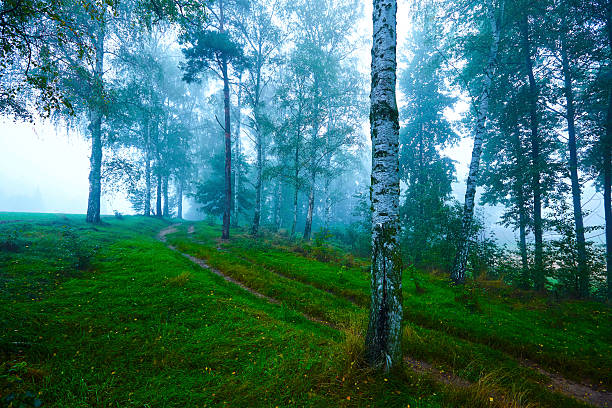
Forest atmospheric quality varies by time of day, season, and weather conditions. Early morning — between 06:00 and 09:00 — typically offers peak phytoncide concentrations as trees activate metabolic processes with rising temperatures. Dew and morning mist can carry dissolved compounds closer to breathing height, creating particularly rich atmospheric layers near the forest floor.
After rainfall, forests release a secondary wave of compounds as wet bark and leaf surfaces interact with air movement. The familiar earthy scent following rain — geosmin produced by soil bacteria — adds its own pleasant associations. Post-rain walks combine woodland scent with the sound and moisture of wet vegetation.
Avoid forest walks immediately after pesticide application or during high pollen count days if you have respiratory sensitivity. Check pollen forecasts on yr.no during May and June when birch and grass pollen peaks across southern Norway. Winter forest walks remain valuable — cold air holds fewer allergens, and evergreen phytoncide production continues year-round.
Choosing the Right Forest Environment
Mixed Conifer Forest
Spruce and pine plantations common in Telemark provide consistent phytoncide levels year-round. Canopy cover reduces wind exposure in winter. Choose marked trails (merket sti) for safe navigation. Bymarka areas near Porsgrunn offer accessible conifer routes within 15 minutes of the city center.
Deciduous Woodland
Birch and oak forests offer peak atmospheric diversity during spring leaf-out and autumn color change. Open canopy allows more ground-level sunlight, supporting understory plant diversity that adds secondary compound layers. Best visited April through October for full sensory experience.
Forest-Water Interface
Routes where forest meets lake, stream, or fjord combine woodland phytoncides with negative ion generation from water movement. These edge environments often support the highest biodiversity and therefore the richest atmospheric compound diversity. Frierfjord forest edges near Porsgrunn exemplify this combination.
Frequently Asked Questions
Answers to practical questions about forest breathing and woodland walking in Norway.
Published research protocols often use 40 to 60 minutes of calm walking. For daily practice, 30 minutes in a forest environment is a practical target for many people. Quality of attention matters — a focused 30-minute walk with nasal breathing and periodic pauses may feel more restorative than a rushed longer hike.
Urban parks with mature tree cover can be a good starting point — generally cleaner air than busy streets and some woodland atmosphere. Deep forest trails often feel quieter and richer in scent, but parks remain accessible and worthwhile. Choose what is safe and convenient for your schedule.
Yes. Evergreen forests continue phytoncide production through winter months. Cold air holds fewer allergens and pollutants. Dress in layers, use traction aids on icy paths, and carry a headlamp during short daylight hours. Winter forest atmospheres are often crisp and clean, with unique sensory qualities from frost, snow silence, and evergreen scent intensity.
For a calmer experience, silence notifications and keep the phone in a pocket rather than in hand. Podcasts or music can distract from natural sounds. If safety requires a phone, enable silent mode and check it only during planned rest stops.